The Christian conviction that the Bible is God’s word means it is important to trust that it includes the correct books. The term canon (from a Greek word for a measuring stick) refers to the standard set of biblical books. Most Bible translations, like the New International Version or English Standard Version, contain the same sixty-six books in them: thirty-nine in the Old Testament (OT) and twenty-seven in the New Testament (NT).
Some Bibles, however, have a longer Old Testament. Roman Catholic Bibles include the deuterocanonical books, while Orthodox Bibles add even more (see Table 1). Protestants call these extra texts Apocrypha (from a Greek word meaning ‘hidden things’) and don’t consider them Scripture, though they are valuable for historical insight (see Table 1). Other ancient Jewish texts called Pseudepigrapha (meaning ‘written under a false name’) are not included in any Bibles.
Roman Catholic OT
Genesis
Exodus
Leviticus
Numbers
Deuteronomy
Joshua
Judges
Ruth
1 & 2 Samuel
1 & 2 Kings
1 & 2 Chronicles
Ezra
Nehemiah
Tobit
Judith
Esther [+ additions]
1 & 2 Maccabees
Job
Psalms
Proverbs
Ecclesiastes
Song of Songs
Wisdom of Solomon
Sirach (Ben Sira/Ecclesiasticus)
Isaiah
Jeremiah
Lamentations
Baruch (including the Letter of Jeremiah)
Ezekiel
Daniel [+ additions]
Hosea
Joel
Amos
Obadiah
Jonah
Micah
Nahum
Habakkuk
Zephaniah
Haggai
Zechariah
Malachi
Orthodox OT
Genesis
Exodus
Leviticus
Numbers
Deuteronomy
Joshua
Judges
Ruth
1 & 2 Samuel
1 & 2 Kings
1 & 2 Chronicles
1 Esdras
2 Esdras (=Ezra)
Nehemiah
Tobit
Judith
Esther [+ additions]
1, 2, & 3 Maccabees
Psalms (+ Psalm 151)
Job
Proverbs
Ecclesiastes
Song of Songs
Wisdom of Solomon
Wisdom of Sirach (Ben Sira/Ecclesiasticus)
Hosea
Joel
Amos
Obadiah
Jonah
Micah
Nahum
Habakkuk
Zephaniah
Haggai
Zechariah
Malachi
Isaiah
Jeremiah
Baruch
Lamentations
Letter of Jeremiah
Ezekiel
Daniel [+ additions]
Appendix
4 Maccabees; Prayer of Manasseh
Table 1: Comparison of Roman Catholic and Orthodox canons. Highlights indicate books that do not appear in the Hebrew Bible or Protestant OT; [+ additions] indicates chapters added to a shared book.
Many people are concerned to know why some Bibles include extra books, and why other ancient texts, like alternative gospels, are excluded. These questions go back a very long way, and there are many misunderstandings about the answers. The reason the sixty-six books form the canon is not because the early Christians particularly favoured these books, or because some church council decided to make them authoritative. Instead, the early church believed that God had given them as Scripture – as the words of God, given through human authors (Zechariah 7:12; 1 Peter 1:10-12). They recognised their inherent divine authority for Christian belief and practice, and believed that they would have that same authority through all generations.
The Old Testament canon
By Jesus’s time, the Jewish Scriptures (the OT) were largely settled, generally consisting of twenty-four scrolls, divided into the Torah (Teaching; often called ‘the Law’), the Nevi’im (Prophets), and the Ketuvim (Writings). Notice how Jesus refers to the Scriptures as ‘the Law and the Prophets’ (e.g. Matthew 5:17) or ‘the Law of Moses, the Prophets, and the Psalms’ (Luke 24:44). The Christian Old Testament’s thirty-nine books come from dividing up the twenty-four scrolls differently, with a slightly different order based on the order in the ancient Greek translation (see Table 2).
Hebrew Bible (Tanak)
Torah (‘Teaching’)
Exodus
Leviticus
Numbers
Deuteronomy
Nevi’im Rishonim (‘Former prophets’)
Judges
Samuel
Kings
Nevi’im Aharonim (‘Latter prophets’)
Jeremiah, Ezekiel
The Twelve (Hosea, Joel, Amos, Obadiah, Jonah, Micah, Nahum, Habakkuk, Zephaniah, Haggai, Zechariah, Malachi)
Ketuvim (‘Writings’)
Proverbs
Job
Song of Songs
Ruth
Lamentations
Ecclesiastes
Esther
Daniel
Ezra (incl. Nehemiah)
Chronicles
Christian Old Testament
Pentateuch
Exodus
Leviticus
Numbers
Deuteronomy
Historical books
Judges
Ruth
1 and 2 Samuel
1 and 2 Kings
1 and 2 Chronicles
Ezra
Nehemiah
Esther
Poetic books
Psalms
Proverbs
Ecclesiastes
Song of Songs
Prophets
Jeremiah
Lamentations
Ezekiel
Daniel
Hosea
Joel
Amos
Obadiah
Jonah
Micah
Nahum
Habakkuk
Zephaniah
Haggai
Zechariah
Malachi
Table 2. Comparison of the contents of the Hebrew Bible (TaNaK) and the Christian Old Testament.
There is significant evidence that Jewish communities saw only these scrolls as Scripture. The apocryphal books were written later (third century BC to second century AD) than the last inspired prophet, Malachi (fifth century BC), and were not seen as Scripture.
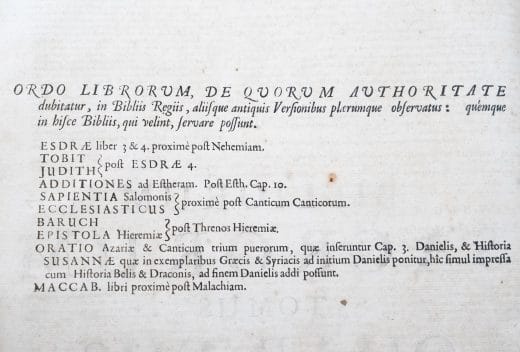
Early Christians debated these books. Jerome, a fourth-century theologian, included some apocryphal material in his new Latin translation (which became known as the Vulgate), but marked them off to indicate that they were different from the main text as they were not authoritative. His contemporary, Augustine, supported their inclusion, however. The Orthodox Church follows Augustine’s view, while the western churches follow Jerome’s.
A thousand years later, during the European Reformation, Martin Luther included the apocryphal books between the Old and New Testaments in his German translation. He gave them the title ‘Apocrypha: These Books Are Not Held Equal to the Scriptures, but Are Useful and Good to Read’, and left them off the contents page. John Calvin later completely rejected all the apocryphal writings, and that became the dominant Protestant view. On the Roman Catholic side, most scholars, including Cardinal Ximénez, saw these writings as secondary, but in 1546, the Council of Trent (a meeting of Roman Catholic Bishops) declared that the debated books were Scripture just as much as those on which all sides agreed.
The New Testament canon
In one way, the New Testament is slightly more straightforward. The NT canon, with its twenty-seven books, is consistent across Christian traditions. In other ways, it is equally complex. One common – but false – idea (popularised by Dan Brown’s The Da Vinci Code) is that the Roman emperor Constantine and the Council of Nicaea decided on the New Testament canon in AD 325.
Early Christians viewed the apostles’ writings as Scripture alongside the Old Testament (1 Timothy 5:18). As well as attributing divine authority to the Hebrew Bible, the writers of the New Testament treated each other’s writings in the same way, at least in some cases (2 Peter 3:16). This is remarkable, revealing their conviction that the Holy Spirit inspired their work in the same way as he inspired the prophets.
The earliest letters from the church fathers cited New Testament passages as Scripture. They treated the four – and only four – Gospels as Scripture right from the beginning. This is especially clear in the second-century writings of Christians such as Ignatius, Justin Martyr, and Irenaeus. It is also clear that they accepted Paul’s letters as having divine authority.
The challenge of heretics
Around AD 140, the heretic Marcion rejected the Old Testament and most apostolic writings other than Luke (which he shortened) and some of Paul’s letters. This may have pushed the early church to clarify the status of Acts, Revelation, and the non-Pauline letters. Since Acts was also written by Luke, that was accepted very early, as were 1 Peter and 1 John (Polycarp and Irenaeus, among others, quote both of them). The earliest Christian writings after the New Testament refer to them in the same way as to Old Testament Scripture: the church saw them as having the same authority.
Seven books (Hebrews, James, 2 Peter, 2 and 3 John, Jude, Revelation) took longer to gain universal acceptance, largely because it took a long time for copies of them to reach all the regions into which the gospel had spread. Yet the church fathers refer to them often enough to show that most Christians did believe them to be Scripture.
It seems that the growing number of heretical texts at the end of the second century prompted more debate. The churches knew that they must not attribute divine authority to the wrong texts. Several writers therefore listed the books that the churches in their region accepted as Scripture. The oldest of these lists is probably the Muratorian Canon, written sometime between about AD 170 and the fourth century. It lists most of the New Testament books, but omits Hebrews, James, Peter’s letters, and 3 John, and includes the Apocalypse of Peter, which was not widely accepted. A small number of other writings were accepted by some early Christians, but not widely, and were finally left out of the canon lists. Of these, the Church Fathers most often refer to the Shepherd of Hermas. Codex Sinaiticus, one of the most famous manuscripts of the whole Bible, includes it, along with the Epistle of Barnabas, though that does not imply that these two texts were considered part of the canon.
Making lists
Athanasius’s ‘Easter Letter’ (AD 367) contains the first listing of the New Testament canon in its final form. It is important to note that Athanasius gives no hint of the church deciding to accept some texts and not others. Instead, he talks about the twenty-seven New Testament books as being ‘God-inspired Scripture’, which the ‘original eyewitnesses and ministers of the word have delivered unto our fathers’ and which ‘have been handed down and confirmed as divine’. He also mentions the Shepherd of Hermas and the Didache as being useful to read, as well as the Old Testament apocryphal books, but stressed that these texts do not carry divine authority.
Of course, that raises the question of how the early church recognised what was ‘God-inspired Scripture’. A key part of this was whether the texts had been written by an apostle or someone very closely associated with apostles (e.g. Mark and Luke). Indeed, 2 Peter 3:16 suggests that the way the apostles viewed each other’s writings started this process. We don’t know who wrote Hebrews, but its contents are fully in line with the apostles’ teaching. The early church sensed God’s authority in these texts and not others. In the modern world, we tend to view things in very rationalistic ways and want evidence-based criteria on which to make our decisions. Much more important, however, is that the Holy Spirit who inspired the writing of these texts also confirmed to the church that they had divine authority. The sixty-six books of the Bible are the word of God, not because some church council decided they were, but because the Holy Spirit guided the church to treasure them above all other writings and to accept the authority of God himself speaking through them.
Further reading
Articles
Kruger, Michael J. ‘The Biblical Canon’. The Gospel Coalition.
Meade, John D. ‘Did Nicaea Really Create the Bible?’ Text and Canon Institute (2021).
Meade, John D. ‘Why Are Protestant and Catholic Bibles Different?’ Text and Canon Institute (2021).
Videos
Licona, Mike. ‘How the Canon of the Bible Was Formed’ (2017).
The Gospel Coalition. ‘Why You Can Rely On the Canon’ – interview with Michael Kruger (2014)
Books
Hill, C.E. Who Chose the Gospels? Probing the Great Gospel Conspiracy. Oxford: Oxford University Press, 2010.
Kruger, Michael J. Canon Revisited: Establishing the Origins and Authority of the New Testament Books. Wheaton, IL: Crossway, 2012
Lanier, Greg. A Christian’s Pocket Guide to How We Got the Bible : Old and New Testament Canon and Text. Tain: Christian Focus, 2023.
Meade, John D., and Peter J. Gurry. Scribes and Scripture: The Amazing Story of How We Got the Bible. Wheaton, IL: Crossway, 2022.
April 4, 2023


Notes
[1] 1–2 Maccabees, Tobit, Judith, Wisdom of Solomon, Sirach (also called Ben Sira or Ecclesiasticus), Baruch, Epistle of Jeremiah, and extra sections in Esther and Daniel.
[2] In addition to the books which Roman Catholic Bibles include, Orthodox Bibles also have 1 Esdras, 3 Maccabees, the Prayer of Mannish, and Psalm 151.
[3] Samuel, Kings, and Chronicles are each split into two; the ‘book of the Twelve’ is divided into the twelve minor prophets; and Ezra and Nehemiah are separate. Some early sources combine Samuel and Kings, and also Jeremiah and Lamentations, so they count 22 books rather than 24.
[4] Psalms, Job, Proverbs, Ruth, Song of Songs, Ecclesiastes, Lamentations, Esther, Daniel, Ezra-Nehemiah, and Chronicles.
[5] Josephus, writing in the first century AD, for example, refers to 22 books.
[6] The Old Latin translation (Vetus Latina) seems to have included some of the apocryphal material.
[7] For example, he added the three extra sections of Daniel and the extra material in Esther. He also translated Tobit and Judith. The Vulgate is not all Jerome’s work: the Old Testament is his translation from Hebrew (except Psalm, which he translated from Greek); the Gospels are based on those in the Vetus Latinus, which he corrected; and the rest of the New Testament is by others. Different versions of the Vulgate include various apocryphal books.
[8] The Muratorian Fragment is a Latin copy of it, dating from the 7th century, which appears to be a translation from earlier Greek
[9] The Shepherd of Hermas and The Epistle of Barnabas are included in Codex Sinaiticus, one of the most famous manuscripts of the whole Bible.