In part one of this two-part article, Peter William’s explains how the account of Paul’s difficult voyage and shipwreck in Acts 27 is a remarkably detailed eyewitness account.
Acts 27 gives one of the most detailed accounts of any sea voyage in the ancient world. Paul had appealed to Caesar so the Roman authorities sent him to Rome by ship from Caesarea on the coast of the Holy Land. Through the workings of a great storm and above all through God’s providence, he landed on Malta where he spent three months. Luke, the author of Acts, was with him the whole time, which is why he could use the pronoun ‘we’ (Acts 27:1) and why he could give such a detailed and gripping account. In this article we will consider both the drama of the events and the evidence that the account is accurate.
A slow start (Acts 27:1-6)
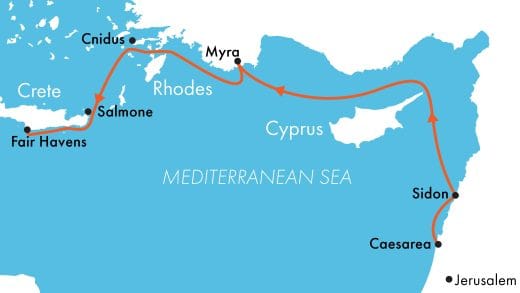
The voyage began normally enough as Julius, the centurion in charge of Paul, commandeered a ship sailing to the west coast of Turkey. Aristarchus – who had already been manhandled by a crazy mob in Ephesus (Acts 19:29) and who ended up a prisoner too (Colossians 4:10) – went along, like Luke, as a free person accompanying Paul and giving him support.
After one day, they put in at Sidon, probably to load more goods onto the ship, and Julius allowed Paul (chained to a soldier, of course) to visit fellow believers. Next, they sailed north of Cyprus, facing some opposing winds, presumably from the west. They then cut across to Myra on the southern coast of Turkey, and that was the end of their relatively uneventful, if slightly slow, journey on the first ship.
At Myra, the centurion commissioned a second ship, which was carrying grain from Egypt – the breadbasket of the Roman empire. Unlike the previous ship, it was heading for their destination in Rome. But this was when serious problems began.
A storm brewing (Acts 27:7-13)
First, Luke tells us, they sailed slowly for many days. They were heading west, but winds coming from the west were against them. With much difficulty, they reached Cnidus, a city at the end of a fifty-mile-long peninsula jutting out to the southwest from Turkey – the last bit of mainland before the Aegean Sea.
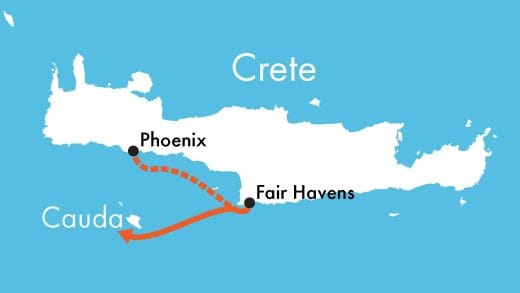
Here, with winds still coming from the west, sailing directly west would have been impossible. So they headed south-west, sailing close to the wind, towards Crete where they could shelter from the wind somewhat. They reached a harbour on the southern coast of Crete called Fair Havens (modern Kaloi Limenes), which may have been fair enough for a small group, but was not felt to be very fair for a large ship with 276 people on board.
The ship’s owner and the captain took the view that it would be best to try to creep west along the coast to a better harbour called Phoenix. Paul advised that this trip would be perilous. The centurion, who was the key decision maker, naturally followed the advice of the owner and the skipper. After all, who was Paul? He was just a prisoner.
We know better, of course. We know from 2 Corinthians 11:25 that by this point Paul had been shipwrecked three times, which was probably more than anyone else on board. But he had no credibility at this moment.
At last, they had a south wind, which would have seemed great for sailing west, and so they set off westwards along the coast of Crete. That was when disaster struck.
All at sea (Acts 27:14-26)
As they rounded the headland four to five miles to the west of Fair Havens, they were struck by a violent wind known as the Euraquilo. We know this is an east-north-east wind, because there are ancient and medieval maps naming the winds. Though Luke’s narrative is the earliest mention of this particular wind, there is also an ancient Roman Forum from Dougga, Tunisia, with the twelve main winds marked on the ground, including this one. The Euraquilo was too violent to be anything but a danger to sailors. It was driving them away from Crete and there was nothing they could do to stop it.
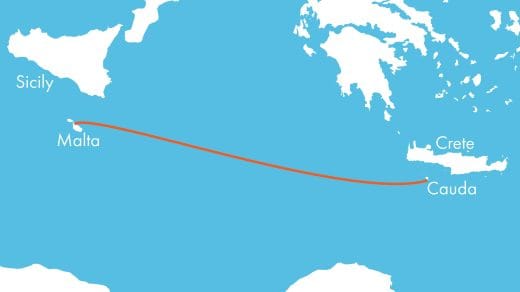
We read of how they got brief shelter near the small island of Cauda (modern Gavdos), south of Crete. They had difficulty bringing the small boat on board (it was probably full of water by now) and they tried to stop the ship from leaking by using undergirdings (Acts 27:16-17).
The storm continued and they were driven in the open sea. The next day, they jettisoned the cargo – the whole economic purpose of the voyage – and the ship’s tackle the following day. The storm continued and they saw neither sun nor stars for days on end, so they would have had little idea where they were. Any attempt at navigation, even with a sea anchor, would have been impossible.
Then Paul stood up, presumably still wearing chains. In normal circumstances this would mean he had no credibility. But right now it was the ship owner and captain who had lost credibility. Paul, by contrast, had publicly given the advice which would have prevented the damage. This was what Paul said:
Men, you should have listened to me and not have set sail from Crete and incurred this injury and loss. Yet now I urge you to take heart, for there will be no loss of life among you, but only of the ship. For this very night there stood before me an angel of the God to whom I belong and whom I worship, and he said, ‘Do not be afraid, Paul; you must stand before Caesar. And behold, God has granted you all those who sail with you.’ So take heart, men, for I have faith in God that it will be exactly as I have been told. But we must run aground on some island. (Acts 27:21-26, ESV)
Paul not only testified about God, but also said that everyone would survive, as God’s gracious answer to Paul’s prayers. He also predicted that they would run aground on some island. The chances of this happening when being blown by a violent wind in the Mediterranean are fairly slim, but this is exactly what happened.
Running aground (Acts 27:27-44)
After fourteen days, whether by sounds, smell, or birds, the sailors sensed land nearby. They took depth soundings of the water: 20 fathoms (37 m), then 15 fathoms (27 m). Then it was time to drop anchors. Unusually, the sailors lowered these from the stern of the ship, which can make for a rougher anchorage, but is better for directing the vessel when they are suddenly released. Sailors tried to slip away in the small boat, but the soldiers, at Paul’s warning, cut it loose. Before morning dawned, Paul spoke again, urging people to eat something and assuring them that they would not perish. He publicly thanked God and ate, and the others, encouraged, joined in.
At daybreak, they didn’t recognise the land but they saw a bay, and the sailors cast off the anchors, abandoning them in the sea, in an attempt to run the ship into the bay. The bow of the ship got stuck on something, probably a sandbank where there were ‘two seas’. The stern was breaking up, and so they had to abandon ship. With a combination of swimming and using parts of the ship as flotation aids, and through God’s miraculous help, they all safely reached land.
Whereas Paul had no credibility when the voyage began, by the end it was clear to everyone on board that God was with him.
Changing views (Acts 28:1-10)
But then it started all over again: Paul had no credibility with the locals, who just saw him as a chained prisoner. While Paul was helping to build a fire, a snake escaped from the wood and fixed itself onto his hand, so the locals assumed that he must be a murderer. But when he suffered nothing bad, they changed their view and thought he must be a god. A few days later, when he had healed the father of Publius, the head of the island, their opinions of him must have risen even further. When they were finally able to leave after three months, they received an amazing send off. God gave Paul success, and Christian witness began on Malta, which the Maltese still celebrate today.
One of the remarkable features of the account in Acts 27–28 is how many features it has of an eyewitness account. The places mentioned on Crete – Fair Havens and Phoenix – were unknown to western travellers and scholars in the Middle Ages and early modern era, but were confirmed by nineteenth-century travellers. The description of the winds is perfect, as well as the position of Gavdos (Cauda) and the shipping details. These sorts of details can’t be easily fabricated and are best explained if Luke experienced the voyage and reported what he saw.
It is an account which is meant to make us see God’s extraordinary providential care for Paul, and the way God enabled him to bear testimony. It also should make us grateful that we are able to read such a gripping and detailed narrative from someone who was there.
April 16, 2026