William Tyndale was the first person to translate the New Testament (NT) into English from Greek, and this was the first NT printed in English. It had an immense impact on the English-speaking world, which reverberates down into our own time.
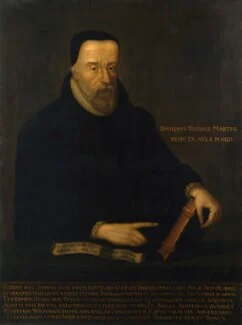
by Unknown artist
oil on canvas, late 17th or early 18th century
NPG 1592
© National Portrait Gallery, London
Jerome translating for the people
Tyndale stands in a long tradition of translating Scripture. The fourth-century scholar Jerome was in some ways the model Bible translator, although he was not the first by any means. In AD 382, Pope Damasus I commissioned him to revise the Old Latin Gospels. Jerome, working with Paula, went on to translate the Old Testament (OT) from Greek and then from Hebrew into Latin, the language of ordinary people. Bruce Gordon, Titus Street Professor of Ecclesiastical History at Yale Divinity School, and author of The Bible: A Global History, says that Jerome is ‘extraordinarily important in embracing this idea that Scripture must speak not only to the people but with their own voice’. The Latin Bible that largely resulted from his work eventually became known as the Vulgate.
Until the invention of the printing press, over a thousand years after Jerome, every Bible had to be copied by hand from earlier manuscripts. This process inevitably introduced errors. After centuries of copying Latin manuscripts there were many variations. The English scholar Alcuin attempted to work out the authentic version of Jerome’s text, presenting a single-volume Bible to Emperor Charlemagne in AD 801, produced under his direction in the scriptorium at Tours. The effort to evaluate and correct Latin manuscripts continued into the twelfth and thirteenth centuries at the newly formed universities in Bologna, Oxford, and Paris. But in mediaeval Europe, Latin was not the language of ordinary people.
Locked away in Latin?
There is a common idea that the Bible was only in Latin in western Europe until the Reformation. But according to Bruce Gordon, much of Europe was a ‘very cultivated world of vernacular translations’. He says that there had been fifteen NTs in German before Martin Luther’s famous version of 1522. The Low Countries were centres of vernacular literature thanks to a growing, affluent, and literate ‘middle class’ of merchants and businessmen who wanted religious literature (such as Thomas à Kempis’s The Imitation of Christ) for use in their private devotional lives.
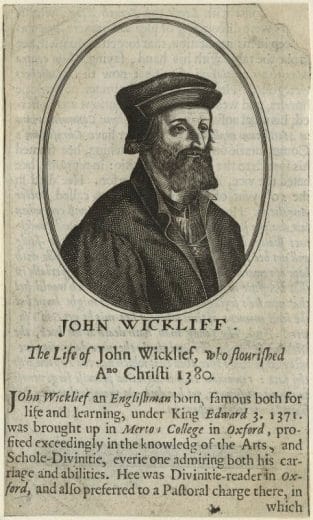
The situation in England was very different. Simon Burton (John Laing Senior Lecturer in Reformation History at the University of Edinburgh) explains that, in the fourteenth century, the Oxford theologian John Wycliffe argued for ‘the supreme authority of Scripture over and above that of the Church . . . and launched a kind of vernacular reform movement known as the Lollards.’ Wycliffe believed that people should have the Scriptures in a language which they fully understand, and said that the Queen of England could have the Gospels in Czech, German, or Latin, so why should they not be in English? This conviction resulted in the first complete Bible in English.
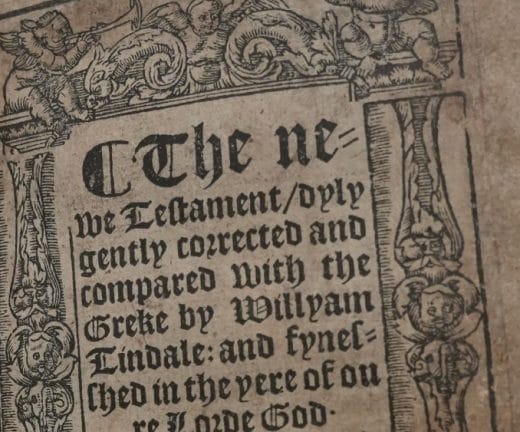
The Establishment saw the Lollards as heretical and dangerous, since they had been blamed for the Peasants’ Revolt of 1381 (which, ironically, Wycliffe himself had opposed). It struck back hard. In 1407, the Archbishop of Canterbury, Thomas Arundel, passed a set of laws (the Constitutions of Oxford) which were explicitly designed to crush Wycliffe’s influence and made it illegal to translate Scripture into English without permission from a bishop.
Growing up with tensions
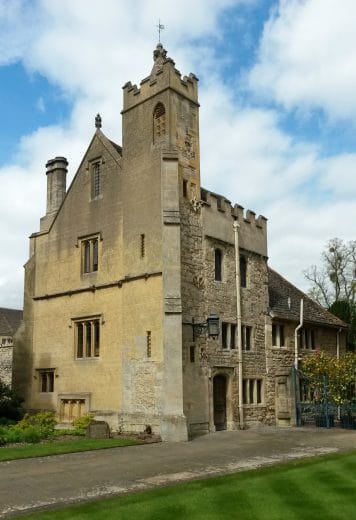
This is the context in which William Tyndale was born in south Gloucestershire in the early 1490s. The area was a stronghold for the underground Lollards. His family were cloth-working merchants – a group among whom Lollard views were particularly strong. So, in the view of Alec Ryrie (Professor of the History of Christianity at the University of Durham) young William would have been ‘strangely inattentive to his surroundings to have not known that these people were out there’. Ryrie also believes that his relative proximity to the border with Wales – with ‘one of the sharpest linguistic disjunctures anywhere in Western Europe’ – may have contributed to Tyndale’s interest in languages: he eventually became fluent in Latin, Greek, and Hebrew, as well as French, German, Spanish, and undoubtedly Flemish.
Tyndale went to Oxford University (as ‘William Hychyns’ – the family used both surnames, probably as a result of a significant marriage) in the early 1500s. He found himself in the middle of a battle between two intellectual schools: scholasticism and humanism (not to be confused with contemporary secular humanism). The scholastics were the ‘old guard’, focused on Aristotelian logic and harmonising that with the writings of the Church Fathers and mediaeval theology. The humanists advocated for a return ‘to the sources’, emphasising the study of Greek and the original biblical texts. As Simon Burton explains, Tyndale was at the centre of this clash:
Tyndale was at Magdalen Hall in Oxford [where] these advanced humanist teachings were very strong. . . . Tyndale identified himself with the humanists, going back to the . . . text of Scripture and the original languages, bypassing the mediaeval tradition of commentary and mediaeval theology.
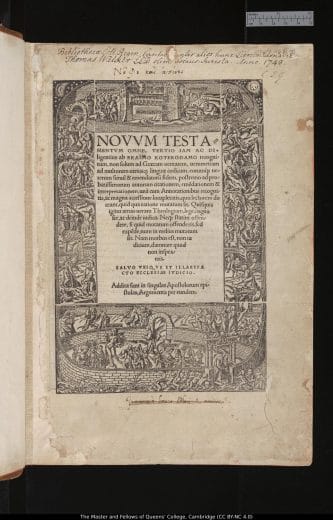
The leading figure of the humanist movement was Desiderius Erasmus. In 1516, he published the Novum Instrumentum, a book that changed the world by printing the Greek text of the NT alongside his new Latin translation that corrected Jerome’s Vulgate. It was Erasmus’s Greek text that made it possible for Tyndale to translate the New Testament from Greek instead of Latin.
A growing passion
Following Tyndale’s time at Oxford, and a period in Boston, Lincolnshire, from where he likely visited Cambridge, he returned to Gloucestershire in 1521 to serve as chaplain and tutor for the family of wealthy landowner Sir John Walsh at Little Sodbury Manor. Tyndale was an open-air preacher in the Lollard tradition, which got him into trouble with the local clergy, and he was summoned to appear before John Bell, Chancellor of Worcester diocese. According to Tyndale’s own account (in the prologue to his 1530 translation of the Pentateuch), Bell gave him a hard time, though took no further action. It was during this hearing that the chancellor claimed that, ‘We had better be without God’s laws than the Pope’s’, to which Tyndale famously replied:
I defy the Pope and all his laws; and if God spares my life, ere many years, I will cause the boy that driveth the plough to know more of the Scriptures than thou dost!
Tyndale was determined to translate the NT into English and in 1523 travelled to London to seek permission from Cuthbert Tunstall, the Bishop of London. Tunstall was a friend of Erasmus, so Tyndale probably expected a favourable response, but Tunstall rejected his request. Tyndale stayed in London before leaving for the continent in 1524, with financial backing from London merchants like Humphrey Monmouth. There he could access the latest linguistic scholarship and far better printers than any in London. He probably spent some time in Wittenberg, where Martin Luther lived, but it is likely that he mastered Hebrew and connected with various Reformers while he was in Worms.
In print at last
By late 1525, Tyndale had translated the NT into English, and he began printing copies in Cologne. As Alec Ryrie observes, it was ‘possibly not the wisest place to go to, right under the nose of one of the highest-profile Catholic princes’ of the Holy Roman Empire. The authorities got wind of it when printing had probably only got as far as the first eight signatures (sheets of four pages). Tyndale, along with his assistant William Roye, escaped and fled to Worms, further up the Rhine, taking with them the printed sheets. One copy, known as the ‘Cologne Fragment’, survives and is today in the British Library. It consists of a prologue by Tyndale, the contents page, a woodcut of Matthew, and Bible text up to Matthew 22:12.
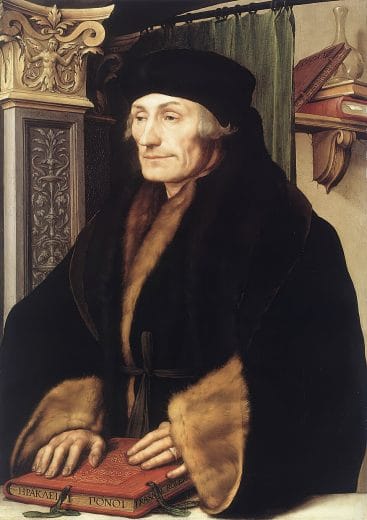
Worms was more sympathetic to Reformation ideas, so Tyndale and Roye were able to get a full NT printed in 1526. Interestingly, this edition did not contain the side notes and cross-references that are found in the Cologne Fragment, perhaps suggesting that it was printed in some haste. It was printed in octavo format, small enough to carry in a pocket.
Like Luther, Tyndale made great use of printing technology to reach audiences in numbers that were unimaginable in the days of hand-copying. Tyndale’s biographer David Daniell suggests that the presses of Peter Schoeffer in Worms may have printed 3,000 copies of the 1526 NT. However, Dr Harry Spillane, a historian of the post-Reformation Bible at the University of Cambridge, believes an initial print run of a thousand copies is much more likely. Even this was a large print run for the time. The copies were smuggled, unbound, down the Rhine and across to England, often hidden in bales of cloth.
A hostile reaction
It is clear that these NTs spread quickly. Karl Gunther, a Reformation historian from the University of Florida, explains that ‘we have evidence of concern on the part of the Church hierarchy about the presence of [Tyndale’s NT] and people reading it.’ He notes that Tunstall issued injunctions for the books to be gathered up, and Archbishop Warham began a campaign to buy up copies to burn.
Tunstall preached a sermon at St Paul’s Cathedral on 24 October 1526 in which he attacked Tyndale’s NT, claiming that he found more than 2,000 errors in it. There were certainly many points at which Tyndale improved his translation in his revised edition of 1534, but Karl Gunther believes that most of Tunstall’s, and later Thomas More’s, criticisms were ‘fundamentally tied up with the theological disputes of the Reformation’.
I beg and entreat…that he would deign to allow me the use of my Hebrew Bible, Hebrew grammar and Hebrew lexicon, and that I might employ my time with that study.
Tyndale’s further work
Tyndale probably stayed in Worms for a couple of years from 1525 before moving to Antwerp. As Alec Ryrie observes, it was a ‘a much better base of operations than either Worms or Cologne would have been’. It was ‘the largest city and port of the Low Countries, which was then one of the greatest concentrations of cities and of wealth in the whole of Europe’, and had a big printing industry.
Ryrie says that Tyndale was ‘able to operate with a remarkable degree of impunity for a number of years.’ He worked on translating the OT from Hebrew, publishing the Pentateuch in 1530 and Jonah in 1531, as well as writing several books of political theology and revising his NT in 1534. By the end of his life in 1536, he had also translated from Joshua at least as far as 2 Chronicles. He also translated the OT lectionary, which included verses from readings across the OT and apocryphal books. This material came into the possession of John Rogers, who had been chaplain to the English merchants in Antwerp. He published it under the pseudonym Thomas Matthew in the so-called ‘Matthew Bible’ of 1537, with the rest of the OT being translated by Myles Coverdale from Latin and German.
Refusing to compromise
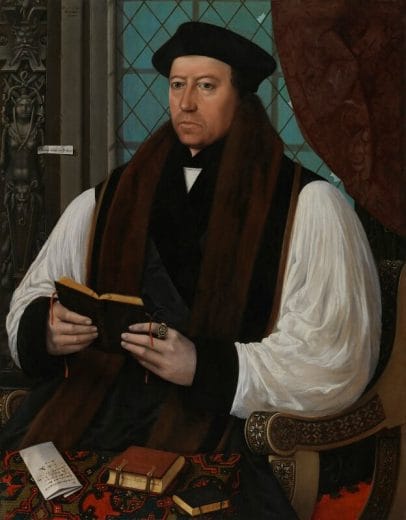
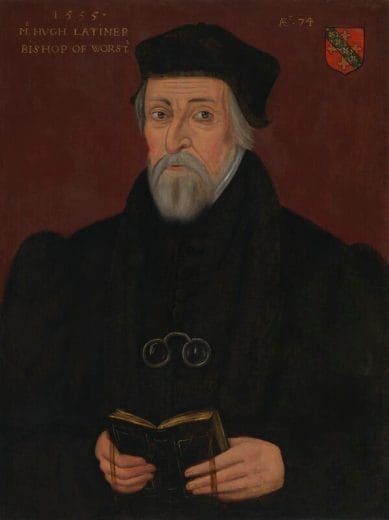
The relative safety of Antwerp did not last, however. Alec Ryrie says that, by the early 1530s, ‘the political ground in England was shifting’. He notes that several evangelicals, including Robert Barnes, Thomas Cranmer, and Hugh Latimer, were willing to accept, to varying degrees, Henry VIII’s divorcing from Catherine of Aragon in order to marry Anne Boleyn ‘in order to achieve God’s work in England’. But, as Karl Gunther comments, Tyndale refused take the same approach. He was ‘willing to defy authorities [and] to court hostility and persecution.’ He describes William Tyndale as ‘somebody who is uncompromising in his beliefs and his willingness to pursue them.’
Betrayal
In 1535, a young Englishman called Henry Phillips, who had run up gambling debts, betrayed Tyndale to the Brabant authorities. He was probably paid to do so by someone senior in the Church of England. In the second volume of her Wolf Hall trilogy about the life of Thomas Cromwell, The Mirror and the Light, Hilary Mantell suggests that this person was Thomas More, though Simon Burton believes that it was more likely to have been John Stokesley, Tunstall’s successor as bishop of London.
William Tyndale was imprisoned in the castle in Vilvoorde in present-day Belgium. There is a letter in the State Archives of Brussels, which he wrote from prison in September 1535 asking for a warmer cap and a warmer coat, and cloth to repair his leggings as he was feeling the cold. But he finished the letter with a much more important – and moving – request:
But above all, I beg and entreat your clemency earnestly to intercede with the lord commissary, that he would deign to allow me the use of my Hebrew Bible, Hebrew Grammar, and Hebrew Lexicon, and that I might employ my time with that study. Thus likewise may you obtain what you most desire, saving that it further the salvation of your soul. But if, before the end of winter, a different decision be reached concerning me, I shall be patient, and submit to the will of God to the glory of the grace of Jesus Christ my Lord, whose spirit may ever direct your heart. Amen.
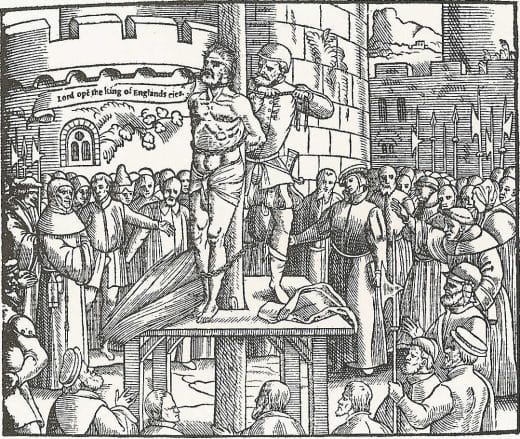
William Tyndale was executed in late September or early October 1536 (it is commemorated on 6 October). He was strangled and then burned. According to Foxe’s Book of Martyrs before he was strangled, Tyndale cried out,
‘Lord, open the king of England’s eyes!’
That prayer was answered – at least in relation to having the Bible in English. Just two years later, on 5 September 1538, Henry VIII’s chief minister Thomas Cromwell directed that there should be an English Bible in every parish church. In 1539, Henry authorised the ‘Great Bible’, which was prepared by Tyndale’s friend and sometime collaborator Myles Coverdale and was effectively a revision of the Matthew Bible combined with Coverdale’s Bible. It included everything that Tyndale had translated (the OT as far as 2 Chronicles, plus Jonah, and the NT), but Coverdale made some revisions to make it less controversial.
The most important Englishman?
Tyndale’s work was, according to Bruce Gordon (Titus Street Professor of Ecclesiastical History at Yale Divinity School, and author of The Bible: A Global History), ‘a generative creative act of culture and language’. That sets him apart in the sense of his extraordinary influence to this day in the English-speaking world. He translated Biblical Hebrew and Greek ‘into the world of sixteenth-century English culture – the way people spoke’, but he is also acclaimed for coining words and phrases which remain familiar today.
Yet Tyndale did not see himself as a revolutionary creating something new. Rather, he saw himself as standing on the shoulders of Jerome, Wycliffe, Erasmus, and Luther in making Scripture available and recovering the essence of historic Christianity. Today, his legacy is so profound that he might well be the most important Englishman who has ever lived.
William Tyndale was the first person to translate the New Testament (NT) into English from Greek, and this was the first NT printed in English. It had an immense impact on the English-speaking world, which reverberates down into our own time.
June 11, 2026