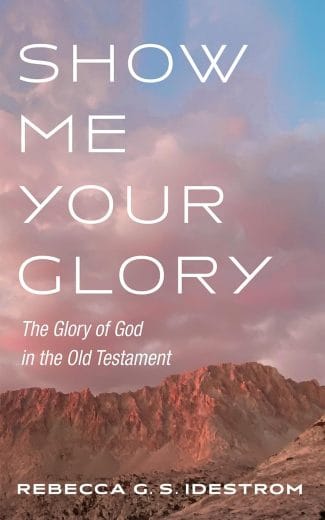
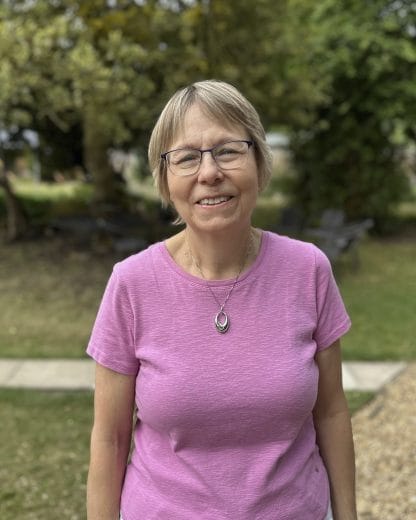
Tony Watkins sat down with Dr Rebecca Idestrom, Professor of Old Testament at Tyndale Seminary, Toronto. They explored her journey in biblical studies and the concept of God’s glory that was the subject of her book, Show Me Your Glory: The Glory of God in the Old Testament (2023), which won the 2025 Book Award of Excellence from the Foundation for Pentecostal Scholarship.
A journey shaped by Scripture
Born in Sweden, Rebecca moved to Canada at the age of ten, where her musical family set her sights on a career in music. ‘I thought I’d study music at university,’ she recalls. ‘However, I attended a Bible college first and fell in love with studying the Bible.’ A talk by a missionary from Israel sparked her interest and she spent a year at the Hebrew University in Jerusalem, studying biblical Hebrew, archaeology, and history. Rebecca reflects that, ‘It changed the direction of my life.’
This pivotal year led to further studies: a second undergraduate degree in Jewish studies and history, a master’s in Old Testament at the University of Toronto, and a PhD at Sheffield University. It was while working on her PhD in the early 1990s that she first came to Tyndale House. She spent sabbaticals here in 2007–2008 and 2014–2015 and has returned every summer since, except during the pandemic. After twenty-four years teaching at Tyndale Seminary, where she chairs its biblical studies department, Rebecca’s passion for the Old Testament is palpable.
The genesis of a fifteen-year odyssey
The seed for Show Me Your Glory took root during Rebecca’s 2007 sabbatical at Tyndale House, though Rebecca laughs at the memory: ‘If I’d known it would take fifteen years, I might not have started!’ The project partly grew from her teaching, particularly courses on Isaiah, Psalms, and an introduction to the Old Testament. She noticed that references to God’s glory were prominent in these texts. But it was Moses’s bold prayer in Exodus 33:18 – ‘Show me your glory’ – that really captivated her.
What struck Rebecca was God’s response. Moses and the Israelites had already experienced God’s glory, through the cloud and fire accompanying them on their journey and then on Sinai. In the wake of the golden calf incident, Moses was anxious about whether or not God’s presence would go with the Israelites. God was pleased with him and said, ‘I will cause all my goodness to pass in front of you, and I will proclaim my name, the Lord, in your presence’ (Exodus 33:19). Then God revealed Himself as, ‘The Lord, the Lord, the compassionate and gracious God, slow to anger, abounding in love and faithfulness, maintaining love to thousands, and forgiving wickedness, rebellion, and sin. Yet he does not leave the guilty unpunished’ (Exodus 34:6-7, NIV). Rebecca’s face lights up as she explains, ‘What surprised me was that God’s glory, revealed to Moses, was more than a spectacular theophany of fire and cloud. It was about revealing his character – his mercy and compassion – in the midst of a crisis. This led me to see that God’s glory is much broader than just his presence; it involves his name and character.’
This revelation set Rebecca on a quest to explore the breadth of God’s glory in the Bible. She likens God’s glory to light refracting into myriad colours when it passes through a prism (a metaphor which she borrowed from her friend, Old Testament scholar Robert Gordon). ‘It’s like a many-faceted jewel,’ she says, ‘revealing different aspects in different contexts.’
From creation to redemption
Rebecca’s book examines all the glory texts within their scriptural contexts, revealing a tapestry of meanings. ‘The meaning of glory varies slightly depending on the passage,’ she notes. Beyond the theophanies– such as the pillar guiding the Israelites or the glory filling the tabernacle in Exodus – she uncovered glory in unexpected places. In Exodus 16, God’s provision of manna is connected to his glory. ‘It made me realise that God’s glory is in his tangible provision,’ Rebecca says, drawing a parallel to Jesus’s miracle at Cana, where turning water into wine manifested his glory (John 2:11).
The Psalms and Isaiah highlight God’s glory being revealed in creation. Psalm 19 declares that the heavens proclaim God’s glory, while Isaiah 6:3’s doxology – ‘Holy, holy, holy is the Lord of hosts; the whole earth is full of his glory’ – can be translated as ‘the fullness of all the earth is his glory.’ Rebecca explains that this suggests that ‘the abundance of creation reflects God’s glory, tied to his divine kingship.’ This insight has implications for environmental ethics, urging us to recognise creation as part of God’s glory.
Rececca says, ‘Another aspect is in Habakkuk 2:14, which speaks of the earth being filled with the knowledge of God’s glory, implying universal acknowledgement of his sovereignty.’ This resonates with the eschatological hope of passages like Isaiah 40 and 66, which anticipate all nations seeing God’s glory.
Ezekiel: a tapestry of glory in exile and restoration
No conversation about God’s glory is complete without Ezekiel, a book Rebecca teaches with enthusiasm. The prophet’s vivid visions of God’s glory frame his call and message. In chapters 1–3, Ezekiel saw God’s glory in exile, challenging the notion that God was confined to Jerusalem’s temple. In chapters 8–11, Ezekiel, a trained priest, but not a high priest, saw into the Holy of Holies in a vision. He witnessed the abominations in Jerusalem prompting the glory of the Lord to leave the temple, signifying the removal of divine protection as the Babylonians approached.
Yet, hope prevailed. In Ezekiel 11:16, God promised to be a sanctuary for his people in exile, and the final vision (chapters 43–44) sees the glory swiftly returning to the temple in the context of purification and a renewed heart for the people. ‘Ezekiel connects these visions,’ Rebecca observes, ‘noting the earth shining with God’s radiance, full of movement and sound, like rushing waters. The river of life in chapter 47, flowing from the throne, signifies healing and restoration, culminating in the city named “The Lord is There”’ (Ezekiel 48:35).
The second temple: a quiet return?
One intriguing question Rebecca tackles is whether God’s glory filled the second temple, built after the exile. Unlike the dramatic fillings of the tabernacle (Exodus 40:34-38) and Solomon’s temple (1 Kings 8:10-11), there is no explicit account of the glory filling it. Yet, Rebecca leans towards the idea that the glory returned, citing Haggai’s promise that God would fill the temple with glory and Zechariah’s implications of divine presence. ‘Matthew 23, where Jesus speaks of the temple and the one who resides in it, supports this view,’ she says. Psalm 132, Joel, and Malachi further suggest God’s dwelling in the temple, as does the reverence for temple worship in Ezra and Nehemiah. ‘It may have been a quiet fulfilment, like the still, small voice in 1 Kings 19,’ she muses.
A legacy of insight
Rebecca’s passion for exploring the different aspects of God’s glory is infectious. From the compassionate character revealed to Moses to the cosmic scope of creation and eschatological hope, her work invites us to see God’s glory as a radiant, multifaceted reality. It’s not just about God’s majesty or power, but God’s glory revealed in salvation, judgment, and provision, as well as mission as God’s glory is declared to the nations.
February 4, 2026