586 BC was the lowest point in the history of the ancient Hebrews. The Babylonians destroyed the temple in Jerusalem, exiled the people to Babylon, and ended the Judaean monarchy. The Bible attests to a period of great tension in the years leading up to this. Incredibly, this is confirmed by eighteen ancient letters written between Judaean military personnel, discovered in the ancient city of Lachish. These give us remarkable insight into the lived experience of ancient Judahites in extreme circumstances.
Lachish has a long history. It was a key stronghold in ancient Judah from the time of Solomon’s son Rehoboam (2 Chronicles 11:11) in the late tenth century BC. However in701 BC, Sennacherib, king of Assyria took the city along with ‘all the fortified cities of Judah’ (2 Kings 18:13). The Lachish Reliefs, which you can see in Room 10 of the British Museum, depict the brutal destruction of the city by the Assyrians.
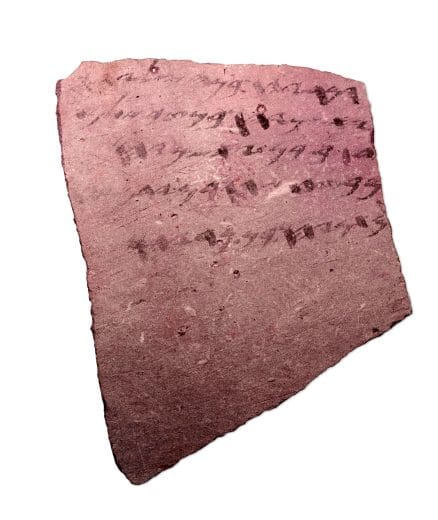
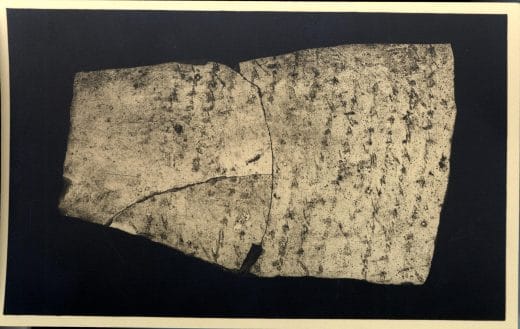
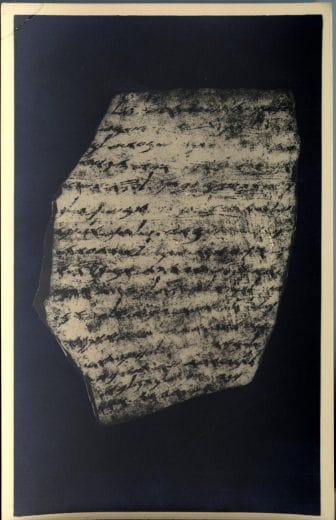
The archaeological record, including the letters, attests to the people of Judah resettling the town until the Babylonians finally destroyed it in 587 BC. When archaeologist James Leslie Starkey excavated the city gatehouse in 1935, he found the letters in Level II, which corresponds to the Babylonian destruction layer. They are written in Palaeo-Hebrew script on pieces of broken pottery called ostraca (singular: ostracon).
The same person seems to have written many of the letters: a junior officer called Hosha-Yahu, possibly at an outpost of the city, writing to his senior, Ya’ush. The longest and most famous of the collection is Lachish 3:
Your servant Hosha-Yahu sends to inform my lord Ya’ush. May YHWH let my lord hear tidings of peace and tidings of good.
And now, please open the ear of your servant concerning the letter which you sent to your servant yesterday, for the heart of your servant has been sick from when you sent it to your servant, for my lord said, ‘You don’t know how to read a letter!’ I swear by YHWH that no one has ever tried to read me a letter! And also for every letter that has come to me, I swear that I read it. And further, I grant it as nothing.
And your servant was told that ‘the commander of the army Cona-Yahu son of Elnathan went down to go to Egypt, and he had sent to take Hodaw-Yahu son of Ahi-Yahu and his men from here.’
And as for the letter of Tobi-Yahu, servant of the king, which came to Shallum son of Yaddua from the prophet, saying ‘Be on your guard!’ your servant is sending it to my lord. (Lachish 3)[1]
The letter opens with a typical greeting, invoking the Lord himself. It seems that it was common in this period to use the divine name, YHWH (known as the Tetragrammaton), before a widespread reluctance to use the name developed during post-exilic times. Swearing by the divine name might seem shocking, although the Bible witnesses to common use of this phrase at the time of the book of Kings (e.g. Jeremiah 38:16).
We see Hosha-Yahu’s panicked state in the way he defends himself against an accusation that he could not read. The fact that he considered it so embarrassing for anyone to think that he couldn’t read suggests that letter writing and reading may have been a reasonably common skill at the time.
Hosha-Yahu refers to a certain commander travelling to Egypt. We have no more details about this event, but it is reminiscent of a biblical account of King Jehoiakim sending some men to Egypt, including Elnathan son of Achbor (Jeremiah 26:22-23). We cannot easily equate the letter’s Cona-Yahu son of Elnathan with Jeremiah’s Elnathan son of Achbor, but the pairing of these names is certainly striking. At the very least, we find a parallel of a small military contingent travelling from Judah to Egypt. Jeremiah 37:5-12 witnesses to Pharaoh Hophrah coming up to aid Judah, so it is conceivable that our letter describes the army commander travelling to request this aid.
A final intriguing question relates to the identity of ‘the prophet’ to whom the letter refers but, tantalisingly, does not name. Evidently, a royal court official named Tobi-Yahu has been circulating a message received by Shallum from a prophet. Whether this is a faithful prophet such as Jeremiah or Uriah (Jeremiah 26:20-23), or a false prophet like Hananiah (Jeremiah 28), we cannot say, but it is striking to note that prophetic words were passed between officials during this high-intensity situation.
Turning to another of the letters, Lachish 4, we find a possible reference to the situation described in Jeremiah 34, in which Nebuchadnezzar was capturing all of the Judaean cities. At one stage, the only fortified cities that were left were Lachish, Azekah, and Jerusalem (Jeremiah 34:7).
Lachish 4 reads as follows (after an introduction resembling Lachish 3), with a couple of small breakages in the ostracon marked by [. . .]:
. I wrote on the papyrus sheet all that you sent me, and although my lord had sent to me concerning the matter of Beth Harapid, there is no one there. And regarding Semak-Yahu, Shema-Yahu took him and brought him up to the city. And your servant is no longer sending him there [. . .] but when morning comes around [. . .], and may my lord know that we are watching out for the fire signals of Lachish, as all the signs which my lord gave, because we cannot see Azekah [or ‘the sign of Azekah’]!
(Lachish 4)
We don’t know exactly what or where Beth Harapid is, but it is apparent that it has been abandoned, perhaps as a result of Babylonian capture. Hosha-Yahu writes that he can no longer see the fire signal (see Jeremiah 6:1 for the use of the same word) of Azekah. This could either be documenting the fall of Azekah, or simply stating that his view of Azekah was not good enough, so he was relying on the signal of Lachish. Either way, we can see that the letter corroborates Jeremiah’s connection of the two cities.
Lachish 5, which is in the British Museum, is poorly preserved and thus difficult to interpret. One interpretation of the ending is as follows:
May YHWH cause you to see the harvest well today. Will Tobi-Yahu bring the royal grain to your servant? (Lachish 5)
It could be that Hosha-Yahu is writing in panic about the threat of a siege (as attested in 2 Kings 25:1), in which the Judaeans need to quickly access royal grain stores. Nebuchadnezzar invaded when the harvest was long finished, and Jeremiah 38:9 indicates the shortage of bread in Jerusalem during the siege there. If it is the same Tobi-Yahu as mentioned in Lachish 3, it makes sense that he is a royal official with authority to disseminate royal grain.
A final letter to discuss is Lachish 6, part of which reads as follows (with sections that have been reconstructed due to faded text):
And look! The words of the [officers?] are not good; to weaken your hands and [to frigh]ten the hands of the m[en]. I know [them]. My lord, will you not write to [them] sa[ying ‘Wh]y are you acting like this?’ (Lachish 6)
This is extraordinary. Jeremiah offered various warnings to the Judaeans, insisting that defeat was certain and so the best option was surrender and exile, with God’s promise that ‘he who goes out to the Chaldeans [=Babylonians] will live’ (Jeremiah 38:2). Naturally, the officials reacted badly to Jeremiah’s words:
Then the officials said to the king, ‘Let this man be put to death, for he is weakening the hands of the soldiers who are left in this city, and the hands of all the people, by speaking such words to them. For this man is not seeking the welfare of this people, but their harm.’ (Jeremiah 38:4)
Hosha-Yahu noticed that his men were slacking. Could it be that they had heard the prophetic words of Jeremiah and are considering surrender? Here we have direct evidence of military leaders acknowledging this phenomenon and considering how to deal with it.
Finally, we must discuss further the names that have occurred throughout these texts, several of which end with ‘-Yahu’. This is the divine name YHWH in a contracted form. (We normally write these names with the ending -iah, as in Jeremiah). So Tobi-Yahu means ‘YHWH is good’, and Hosha-Yahu means ‘YHWH saves’. The Bible also witnesses to a high number of names like these during the monarchic period as well as after the exile, but during the later periods, a short spelling ‘-Yah’ eventually replaced this longer ‘-Yahu’. The fact that these ancient, pre-exilic texts from Lachish have this longer spelling ‘-Yahu’ fits the overall biblical trend of pre-exilic ‘-Yahu’ and post-exilic ‘-Yah’. Providing extra evidence, Lachish 1 (also displayed in the British Museum) is a simple list of ten names, eight of which have the ‘-Yahu’ suffix,
We have seen that the Lachish letters complement the biblical account well. They give us a window into the anxiety of the period, affirm minor details such as the key cities involved, and illustrate the drama accompanying the circulation of prophetic messages. They don’t ‘prove’ the biblical account of this period in Judah’s history, but they do show that what the Bible says is entirely consistent with what we can see from the archaeological record.
[1] All translations are the author’s own.
For more on this, listen to or watch the Tyndale House Podcast, which features two series about names in the ancient world and the Bible. Look out for future progress of the Old Testament Names project at Tyndale House
Josh Meynell is a PhD candidate at the Hebrew University of Jerusalem.
February 4, 2026